It can be very hard to figure out what Edo looked like. The city that was gradually replaced by Tokyo during the Meji restoration was very different from the Westernized capital that quickly grew up in its place. That capital in turn was replaced by a very different city after WWII, when the city was reduced to a pile of rubble. But there is a place where you can figure out what the city looked like, and how people lived in it. In life-sized dioramas. Read on to find out more.
Look at old Japanese woodcuts. While they typically show objects of interest, for instance Mt Fuji, they also tend to show the daily life of everyday Japanese. An artist such as Hokusai always included aspects from the everyday Edo in his pictures. And they are possible to look at today, and get a feeling for how life in the city would have looked before the drastic Westernization during the end of the 19th century.
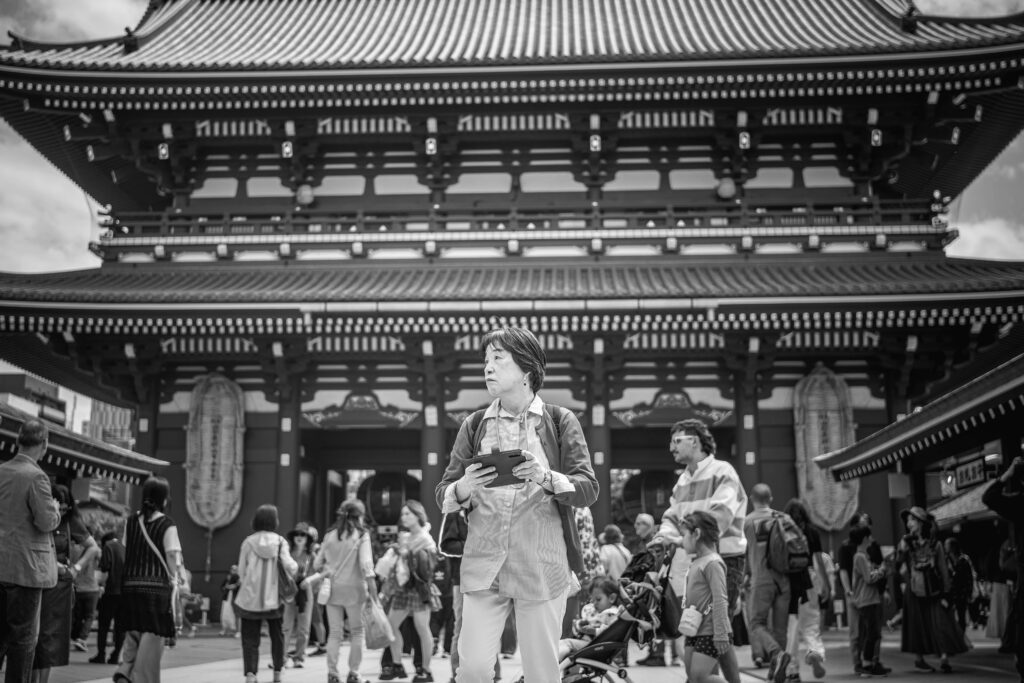
The Kaminarimon in Asakusa is one of the few places in Tokyo that would have looked the same in Edo.
What Old Edo Can Teach Us About Tokyo
Occasionally you may meet people nostalgic for the ways of Old Japan, but there is no reason to be nostalgic for life during the rule of the shogun. Japan was a military dictatorship, but not only that. You could not choose your profession or partner; you were assigned your station in life, you had to dress and wear your hair accordingly. Transgressions were punished by a murky legal system, often by death.
The Edo that became Tokyo was full of social inventions.
Yet this was a country where innovation consistently filled the gaps of the repression. Rice futures were invented in the 17th century, and the Osaka stock exchange was a lively trading place; new foods like sushi and dorayaki emerged apace. And while there were no stores as such, the first department store in the world was opened in Japan. Yet the deference to the feudal lords and the samurai class dominated all levels of life.
There is not much left of the old Edo, which changed completely when it turned into Tokyo, the Eastern Capital. And again and again through natural disasters and war.
If you want to get a feeling for life in a country which would be as alien to today’s Japanese as it is to foreign visitors, you should go to the museum dedicated to this matter – the Edo Tokyo Museum. This museum shows how Edo became Tokyo, and also how Tokyo became what it is today.
The Edo-Tokyo Museum is a celebration of how Edo became Tokyo.
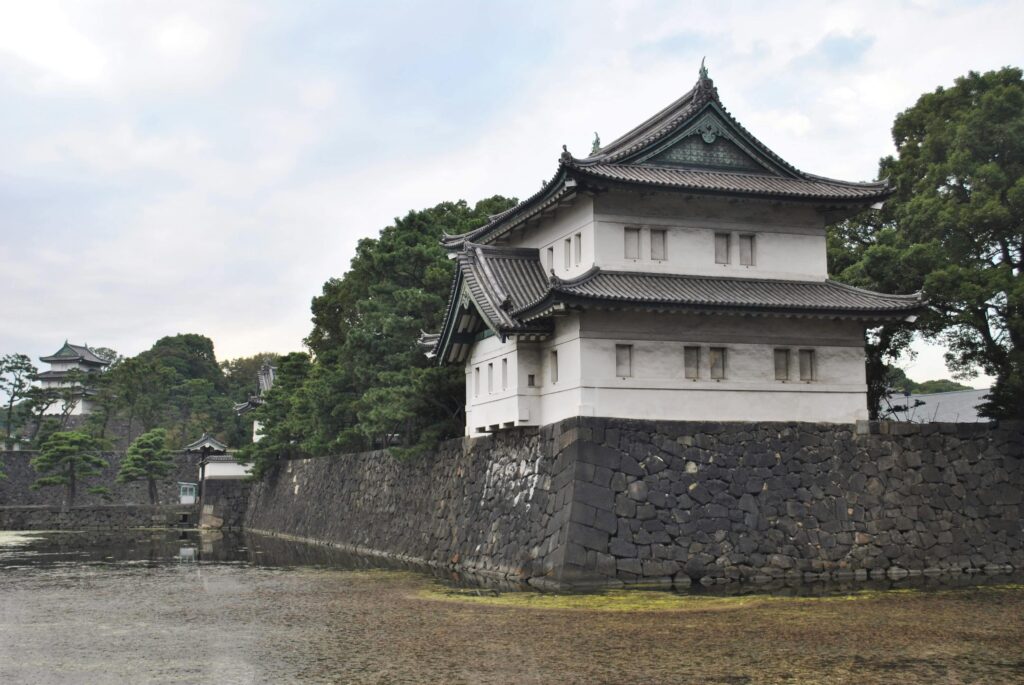
Located on historic Tokyo ground next to the main sumo wrestling arena in Ryogoku, on the eastern shore of the Sumida river across from Asakusa, the Edo-Tokyo Museum is a must for anyone visiting Tokyo and hoping to understand what they are seeing. While you can occasionally spot Edo in Tokyo today, especially around the Edo Castle (what today is the Imperial Palace), you might not realize what you are seeing. It may be hard for a foreigner to tell a memorial stele from a road marker, especially if it is your first time in Japan.
Merely approaching Edo Castle could have cost you your life.
While there are plenty of signs out in the streets telling you what you are seeing (you can tell that they are very pedagogically done), they are typically in Japanese only.
On top of that, it is hard if not impossible to imagine what parts of the city would have looked like then. Nihonbashi, the center of Edo, looks nothing like what it would have looked like two hundred years ago. Even if the surroundings of Edo Castle might look the same today as when they were built, the way they were used would have been completely different. What are parks today was defense works for one of the most paranoid military regimes around. Nobody would have dreamt of going boating in the castle moat, even during cherry blossom season. If you did, you would have been killed instantly.
The city changes from the mid-19th century are nothing short of incredible.
How Tokyo changed when the city started to embrace western practices is part of what you can see in the museum, even if it is hard to imagine how life would have changed for anyone going from being forced to kowtow for hours when a lord and his entourage passed by, and not daring to get up lest you lost your head; into someone dressed in top hat and trousers, enjoying gramophone music and taking the train from Yokohama to Shimbashi, instead of walking.
Inside the Edo-Tokyo Museum
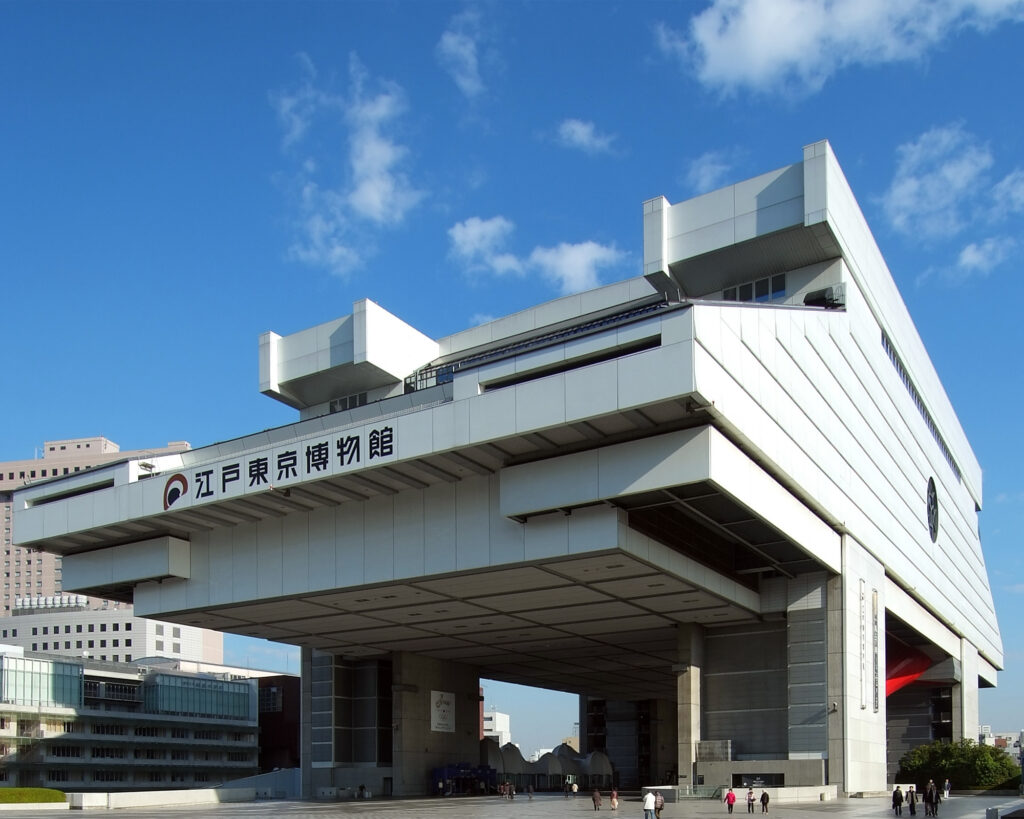
The museum building is an attraction in itself, although the only surrounding museums is the museum dedicated to the Great Kanto Earthquake in 1923 and a museum showing ancient samurai swords which probably will be open by appointment only. And the sumo museum inside the sumo arena, but that may be very hard to make sense of unless you are really interested in the sport.
But inside the building of the Edo-Tokyo Museum, which may look to modern eyes like a dog robot but is supposed to be based on an ancient rice storage house, you will be able to see what things looked like when Tokyo was Edo. At the center of the museum is a huge diorama of the Nihonbashi area, showing how it looked like when the Edo was the largest city in the world in the 19th century.
Those are only a few of the exhibits in this museum, which leans heavily on dioramas to demonstrate what the city would have looked like. Rather than picking up single objects, the museum focuses on illustrating what life was like. Especially for ordinary people.
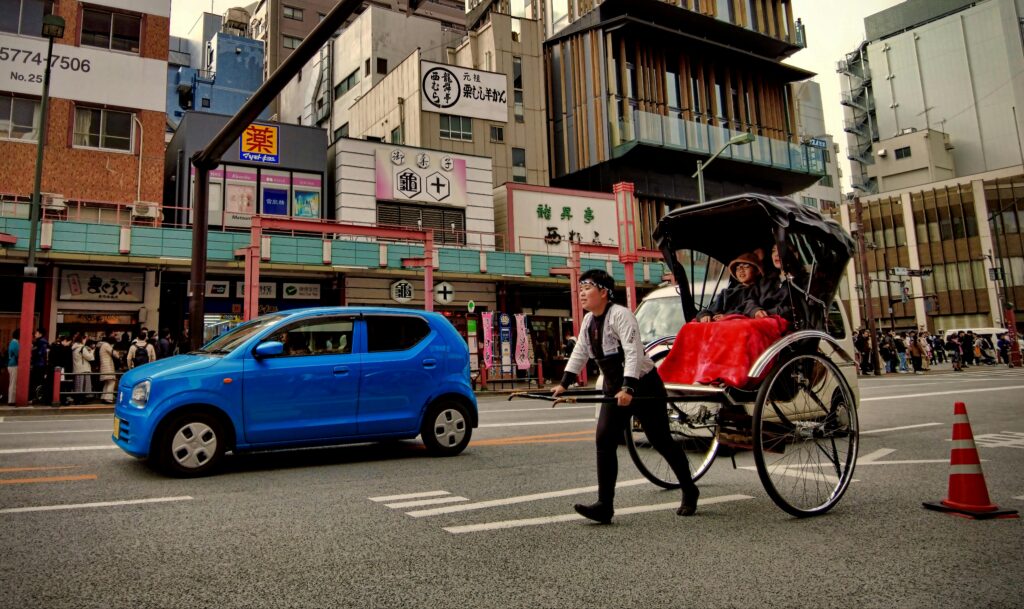
Rikshaws (a Japanese word) was part of the innovations in the 19th century.
This includes dioramas showing the Showa era, the period after WWII which was when the Japanese economy was booming and the country grew faster than any other in the world. There is still huge nostalgia for the period, and the way of life that supposedly was part of the lifestyle after the war. And naturally a museum with Tokyo in its scope has to pick this up; there are actually several museums, part of the same organization which runs the Edo-Tokyo Museum, which focused on the lifestyle in the cramped Tokyo near suburbs. The Shitamachi museum, in particular, is a museum dedicated to the life of the servant class. Their part of the city was known as the ”shitamachi”, the lower city. When the Meiji revolution swept in, the servants quarters morphed into a neighborhood where families cared for each other, at least in the ideal world of the Tora-san films.
In case you are trying to make sense of Tokyo, the Edo-Tokyo Museum is an incredible resource that lets you put the history in place, enabling the old city to emerge out of the huge place that has grown over it.
Stay tuned for more exciting content like this! Follow us on our social media platforms and check out our blog regularly to stay updated on the latest news, trends, and insider stories from Japan. Don’t miss out on future updates. Sign up for our newsletter for exclusive content delivered straight to your inbox!
Wisterian Watertree
Wisterian Watertree has been living in Tokyo and other Japanese cities for
the past 20 years, helping visitors get the best of Japan. He is the author of two
books, ”Take Your Toddlers To Tokyo” and ”Driving In Japan”, with more on the
way. You can read more on his website Japan Top 10, https://japan-top-10.com.