When Japan opened up to the world in the late 19th century, traditional music was one of the first victims. Western music was a much better noisemaker than the traditional instruments, and you still occasionally see small troupes — dressed more or less like clowns — who perform outside the main train stations, advertising pachinko parlors.
When Japan met the West, it did not produce musical works of the potency of the art that transformed the art of the early French impressionists. Tokyo Guitar Street: Where Tokyo Tunes Itself by Hand
Tokyo has entire districts devoted to electronics, fashion, books, or food. Guitar Street is smaller, quieter, and far more specific — and that specificity is exactly why it matters. Officially, there is no sign that says “Tokyo Guitar Street.” Unofficially, anyone who plays, collects, repairs, or obsesses over guitars knows where it is: a short stretch around Ochanomizu Station, where instruments have been bought, sold, argued over, and lovingly maintained for nearly a century.
This is not a theme street created for visitors. It emerged organically, and it remains functional. Guitar Street exists because people still use it.
Where Is The Tokyo Guitar Street (and Why It Ended Up There)

Tokyo Guitar Street is centered on Meidai-dori Avenue in the Ochanomizu / Kanda-Surugadai area, spanning parts of Chiyoda-ku and bordering Bunkyo-ku. Japanese sources routinely describe the area as gakki-ten gai — a musical instrument shopping district — with guitars as its most visible specialization.
Getting there is simple and symbolic. Ochanomizu Station is served by the JR Chūō Line (Rapid and Local) and the JR Sōbu Line, with Tokyo Metro access nearby at Shin-Ochanomizu (Chiyoda Line). You exit the station, cross the Kanda River, and immediately see shop windows filled not with clothes or electronics, but necks, bodies, and strings stacked floor to ceiling.
The reason this area became Guitar Street is practical, not romantic. Historically, Ochanomizu developed as a student district, anchored by universities such as Meiji University, Nihon University, and several music colleges. Japanese urban histories note that instrument shops followed students, teachers, and performers. By the 1930s, specialist music stores were already clustered here, and after World War II, the concentration intensified as Western music gained popularity in Japan.
In other words, Guitar Street exists because demand never left. Not One Street, but an Ecosystem
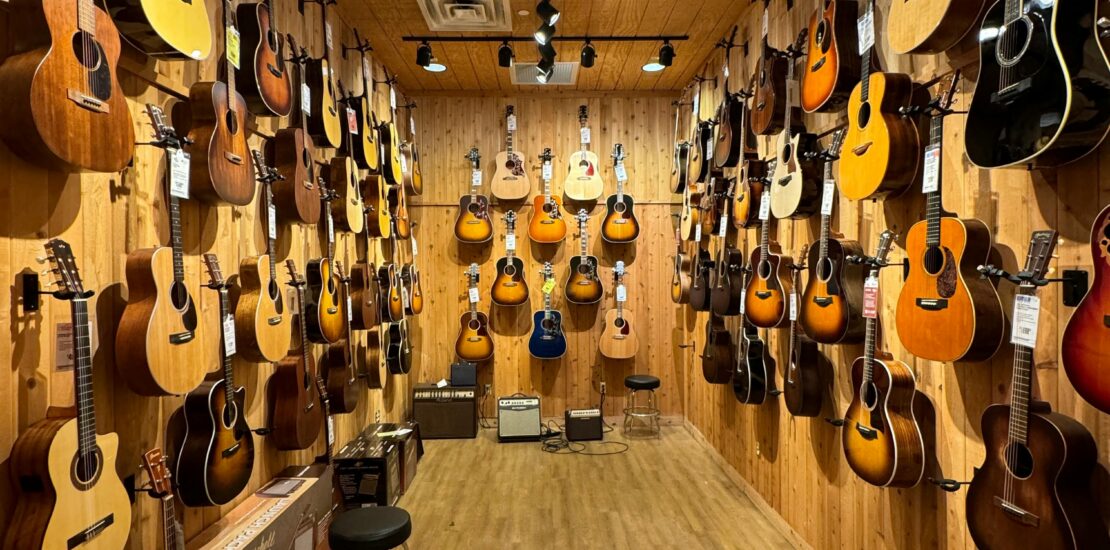
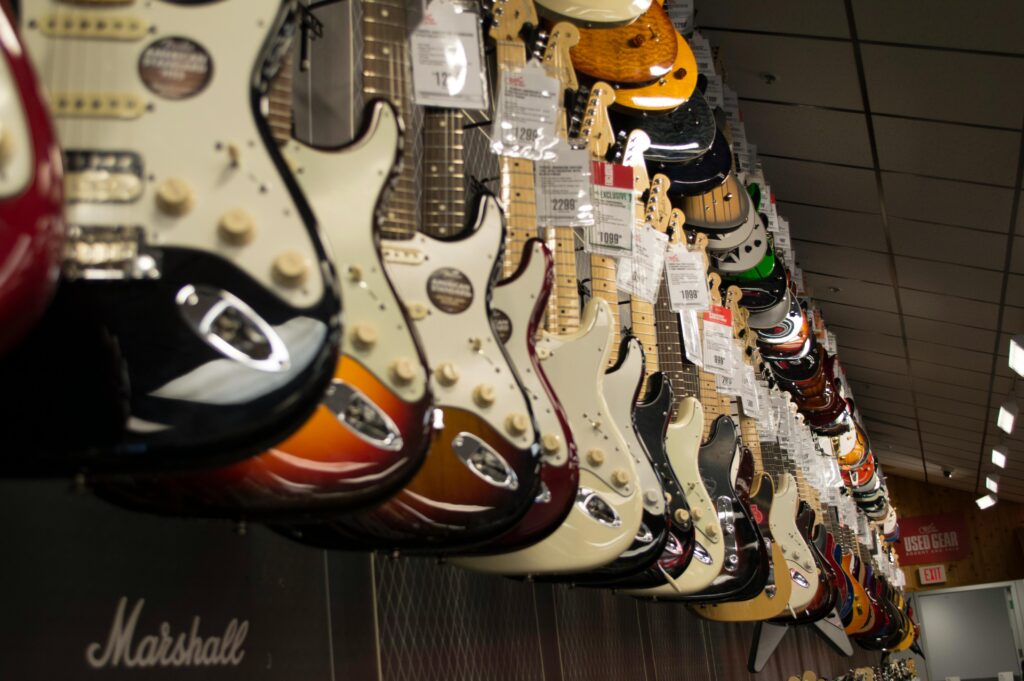
Calling it “a street” is slightly misleading. Guitar Street is better understood as a dense ecosystem of independent retailers, each with a distinct personality. Some shops specialize in vintage American instruments. Others focus on Japanese-made guitars from the 1960s and 1970s — brands like Greco, Tokai, or Fernandes that Japanese sources increasingly frame as cultural artifacts rather than mere copies.
There are stores dedicated to acoustics, jazz archtops, metal shred machines, boutique pedals, amplifiers, repairs, and custom builds. Large chains exist here too, but they coexist with tiny, family-run shops where the owner might be the repair technician, buyer, and historian all at once.
Japanese guitar magazines and retailer histories frequently emphasize this coexistence as Guitar Street’s defining trait: competition without homogenization. Shops survive by knowing something specific and doing it well.
Why Guitar Street Is a Sight Worth Seeing
Even if you don’t play guitar, Guitar Street works as a form of applied Tokyo anthropology. You can watch how specialization functions in a dense city. Each shop window communicates clearly: this is what we do. There is no lifestyle branding, no forced coolness. The instruments are the message.
For players, the appeal is obvious. Nowhere else in Tokyo allows you to try dozens of instruments across multiple shops within a single afternoon. Japanese consumer guides regularly note that prices here are competitive precisely because comparison is effortless.
For non-players, the appeal is quieter but real. Guitar Street is one of the few places in central Tokyo where craft, commerce, and expertise are fully visible. Repairs are done on-site. Staff discuss wood, wiring, and decades-old production runs with casual fluency. You see skill being exercised, not abstracted.
This is why Guitar Street appears repeatedly in Japanese cultural writing as an example of machi no shokunin — urban craftsmanship surviving modern retail.
Japanese Guitars, Japanese Identity
One reason Guitar Street has gained renewed attention in recent years is a reassessment of Japanese-made guitars. For decades, Japanese instruments from the postwar period were framed as imitations of American originals. Japanese scholarship and collector culture now push back against that narrative.
Brands produced in Japan during the 1960s–1980s are increasingly valued for their build quality, materials, and unique design decisions. Guitar Street shops were instrumental—literally and culturally—in preserving these instruments when they were unfashionable. Japanese sources often credit Ochanomizu retailers with keeping domestic guitar history alive long before it became collectible.
This gives Guitar Street a role beyond retail: it is a custodian of material culture.
How to Visit (Without Getting in the Way)
Visiting Guitar Street is easy, but there are unwritten rules—very Japanese ones.
Most shops welcome browsing. Many encourage trying instruments. But respect matters. Ask before plugging in. Handle guitars carefully. Understand that some instruments—particularly vintage pieces—are there as much for study as for sale.
Japanese shop guides often mention that staff may appear reserved at first. This is not unfriendliness; it is professionalism. Demonstrate genuine interest, and conversations open quickly.
Weekdays are calmer. Weekends bring crowds, including students, professionals, and international visitors. There is no admission fee, no ticket, no curated route. You move at your own pace.
The Sound of the Area
One of Guitar Street’s subtle pleasures is its soundscape. Unlike electronics districts where noise is constant, here sound appears in fragments: a jazz chord drifting out of one shop, a fuzz pedal being tested in another, a quiet acoustic scale from a back room.
Japanese urban commentators sometimes describe this as oto no ma—spaces between sounds. Guitar Street doesn’t overwhelm you; it invites you to listen.
Why Guitar Street Still Exists
In an era of online shopping, Guitar Street should not exist. And yet it does. Japanese economic analyses of specialist districts suggest the reason is trust. Instruments are tactile, subjective, and personal. You want to feel them, hear them, talk about them.
Tokyo Guitar Street survives because it offers something the internet can’t: context. You don’t just buy a guitar; you buy it knowing what sits next to it, what came before it, and what kind of person usually plays it.
A Living Street, Not a Museum
Guitar Street is not preserved. Shops open and close. Trends shift. Metal rises, jazz recedes, then returns. But the street adapts without reinventing itself. Japanese municipal and cultural references often describe Ochanomizu as a place where continuity is maintained through use, not nostalgia.
That is the key. Guitar Street is alive because it remains useful.
If Tokyo is a city that constantly reinvents itself, Guitar Street is proof that reinvention is not the only path forward. Sometimes, doing one thing well, in the same place, for a very long time, is enough.
And in a city famous for noise, Guitar Street remains one of the few places where Tokyo listens to itself.
Sources checked and cross-referenced:
Japanese Wikipedia entries on Ochanomizu and Surugadai (history, student district); Japanese-language overviews of Ochanomizu instrument shops (gakki-ten gai); retailer histories from major Ochanomizu guitar stores (Japanese); Japanese music magazines and collector commentary on domestic guitar production; JR East station information for Ochanomizu; Chiyoda City cultural area descriptions; English-language Tokyo guides
Stay tuned for more exciting content like this! Follow us on our social media platforms and check out our blog regularly to stay updated on the latest news, trends, and insider stories from Japan. Don’t miss out on future updates — sign up for our newsletter for exclusive content delivered straight to your inbox!