She is the grand old lady of the Tokyo cityscape, permanently ready to pull up her legs and walk like a giant robot across the streets of Tokyo. Meet Tokyo Tower, the symbol who is now able to focus on her job: Symbolizing Tokyo.
She is the grand old lady of the Tokyo cityscape, permanently ready to pull up her legs and walk like a giant robot across the streets of Tokyo. Meet Tokyo Tower, the symbol who is now able to focus on her job: Symbolizing Tokyo.
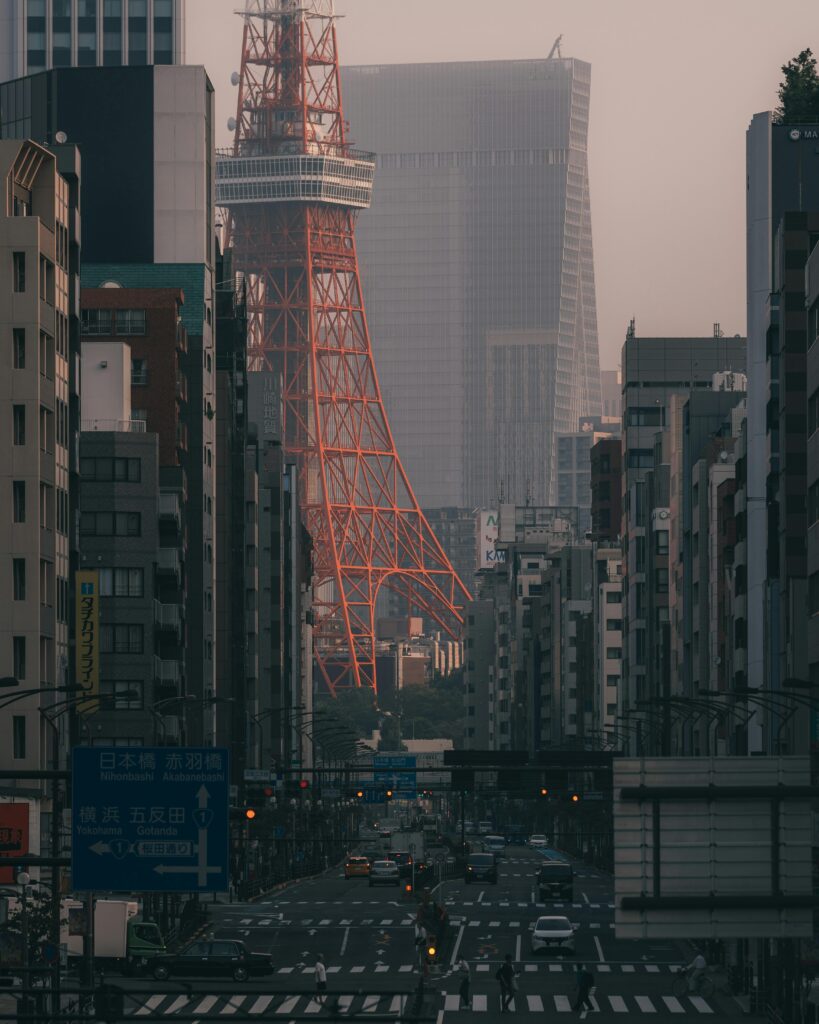
If you’ve been in Tokyo for more than a day, you’ve probably seen it without trying. Between office blocks, from the skyscraper view, or framed perfectly at the end of a street in Minato-ku, Tokyo Tower keeps turning up like a familiar face in a crowd. It is not the tallest thing in the city anymore (not even close), but it remains the most visible landmark — an icon you can recognize at a glance, even when everything else in Tokyo feels like it’s moving at commuter speed.
Tokyo Tower officially opened on December 23, 1958, at a time when Japan was pushing hard into a new era of television broadcasting and postwar reconstruction. Its formal name is “Nippon Denpatō” (Japan Radio Tower), and the original purpose was practical: to transmit TV and radio signals across the Kanto region from one high point.
But practicality alone doesn’t make a symbol. Tokyo Tower became famous because it packaged engineering, optimism, and a little bit of showmanship into a single silhouette.
The “showmanship” begins with the height: 333 meters. It’s a number that feels almost too neat, and people have been inventing stories about it ever since. The tower’s own official “Towerpedia” explains that the height was calculated as what was needed for VHF television coverage across the region — yet it also acknowledges the founder Hisakichi Maeda’s ambition to surpass the Eiffel Tower, because if you are going to build a modern national monument, you might as well do it with confidence.
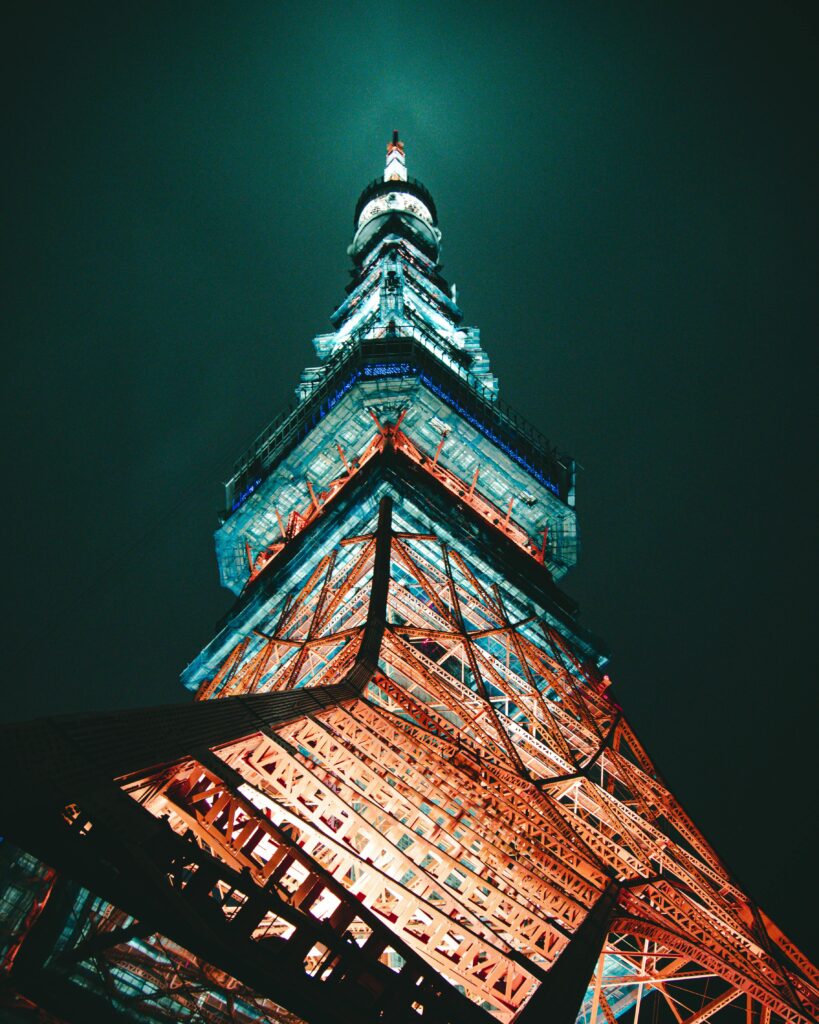
The brains behind making it stand up in earthquake country were led by Tachū Naitō, a structural engineer often called the “father of earthquake-resistant design” and famously associated with multiple Japanese towers.
In other words, Tokyo Tower wasn’t just designed to be tall. It was designed to keep standing tall, even when the earth shakes.
Then there’s the paintwork. People casually call it “red and white,” but Tokyo Tower is more strictly “international orange and white,” a scheme used for aviation visibility. Most other radio transmission towers in Japan are painted according to the same color scheme, but none stand out like Tokyo Tower. A curiosity is that the tower’s aviation-marking color pattern and the number of color bands have changed over time (from 11 divisions to 7 in 1986).
The result is that Tokyo Tower looks festive in daylight — almost cheerful — while its more futuristic successors often look like expensive office equipment.
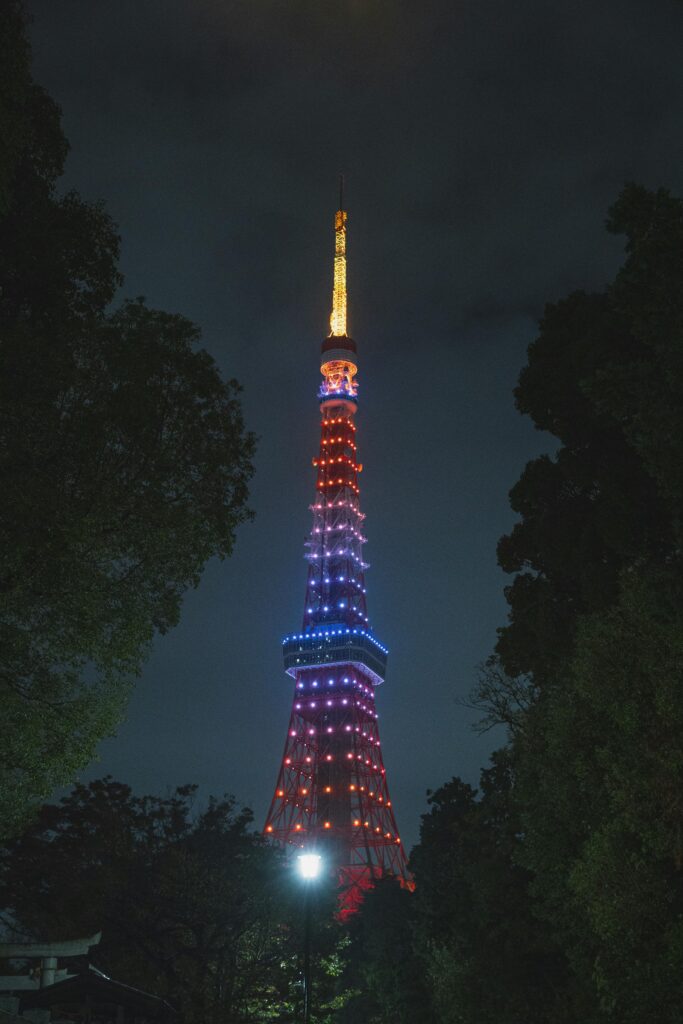
The illumination of Tokyo Tower is part of the appeal.
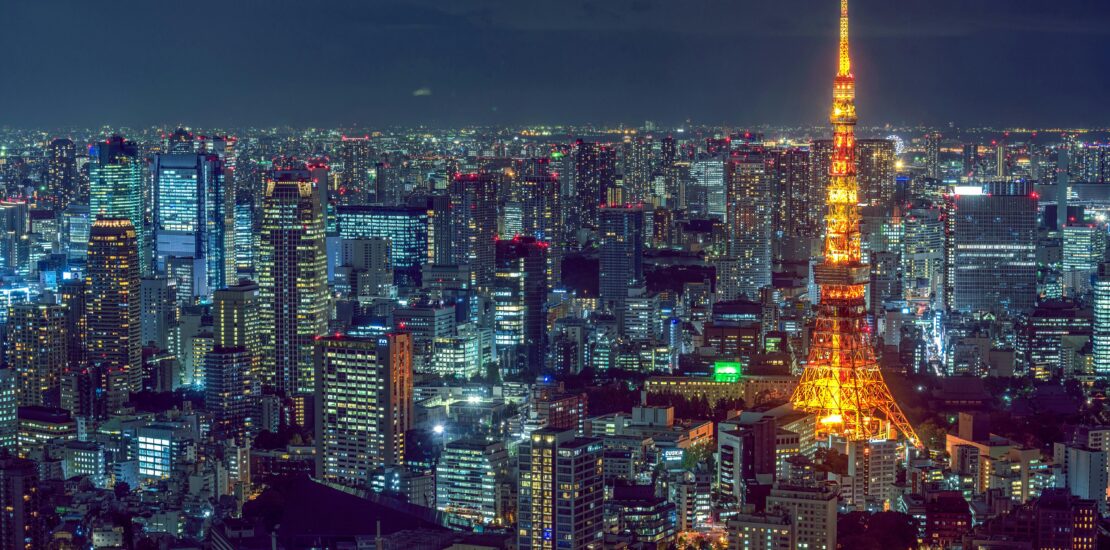
For many visitors, though, the real Tokyo Tower experience begins after sunset. Its lighting has its own lore. The tower’s official site details the long-running “Landmark Light” illumination (in place since 1989) and the newer “Infinity Diamond Veil” LED system introduced in 2019, designed to create many different color patterns. The location and the width make it a more interesting target for illumination than the Tokyo Sky Tree, which, after all, just forms a straight line into the sky, no matter the color it is lit.
This is a big part of why Tokyo Tower stays popular in photos: it doesn’t just exist at night, it performs.
Tokyo Tower’s observation areas are split between the Main Deck at 150 meters and the Top Deck at 250 meters.
That difference matters more than you might expect. From the Main Deck, Tokyo still feels human-scaled: you can pick out neighborhoods, parks, and the geometry of roads. From the Top Deck, the city becomes a texture — an endless, glittering arrangement of grids and rivers.
The admission is not cheap. For the Main Deck (150m), the adult price is ¥1,500. For the Top Deck Tour (150m & 250m), adults pay ¥3,300 online or ¥3,500 at the counter (with reduced rates for students and children).
Hours listed there run late (Main Deck up to 23:00, Top Deck Tour up to 22:45, last admissions shortly before).
Which makes perfect sense, because — just like with the Sky Tree — the sunset is magical; but since you are so much closer to street level, you can enjoy the illuminations of the surrounding areas.
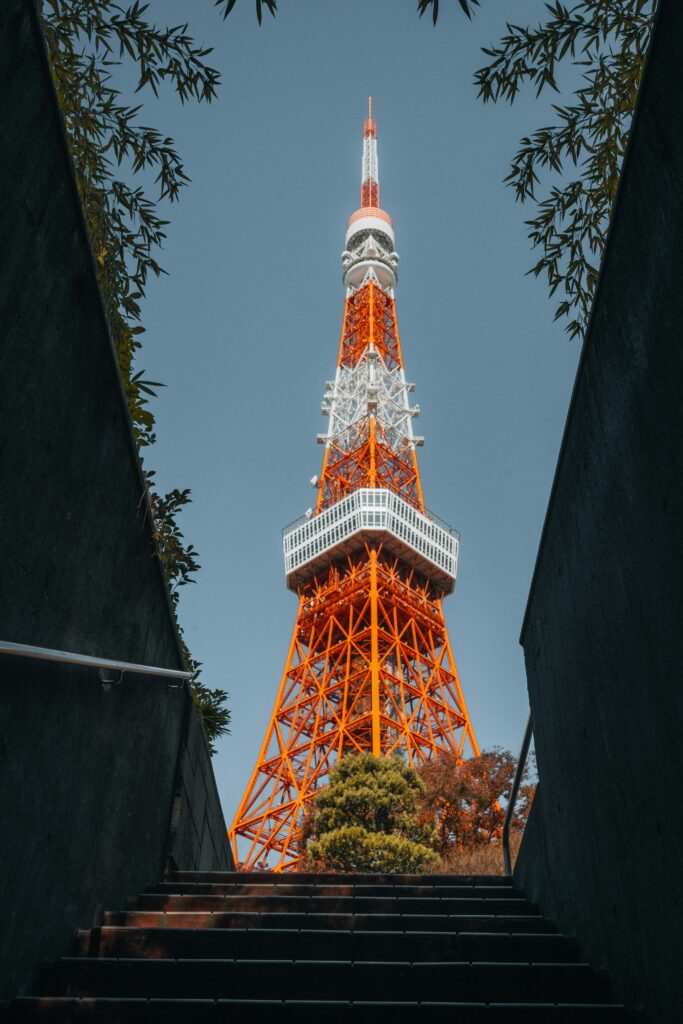
One detail that fits Tokyo Tower’s “classic Tokyo” personality: you can also climb it. The tower has an outdoor staircase route to the Main Deck (around 600 steps) that is open under limited conditions.
In a city where almost everything is escalators and ticket gates, voluntarily climbing a landmark feels oddly refreshing — like you’ve stepped into a slightly older Tokyo where effort was part of the fun.
Tokyo Tower sits in Shiba Park, Minato-ku — one of Tokyo’s central wards that also contains embassies, corporate headquarters, and several major nightlife districts.
The location is strategic in a way that still makes sense today: it’s close enough to the center that the skyline looks dense and dramatic, but it’s not wedged between buildings so tightly that the tower can’t “breathe” visually.
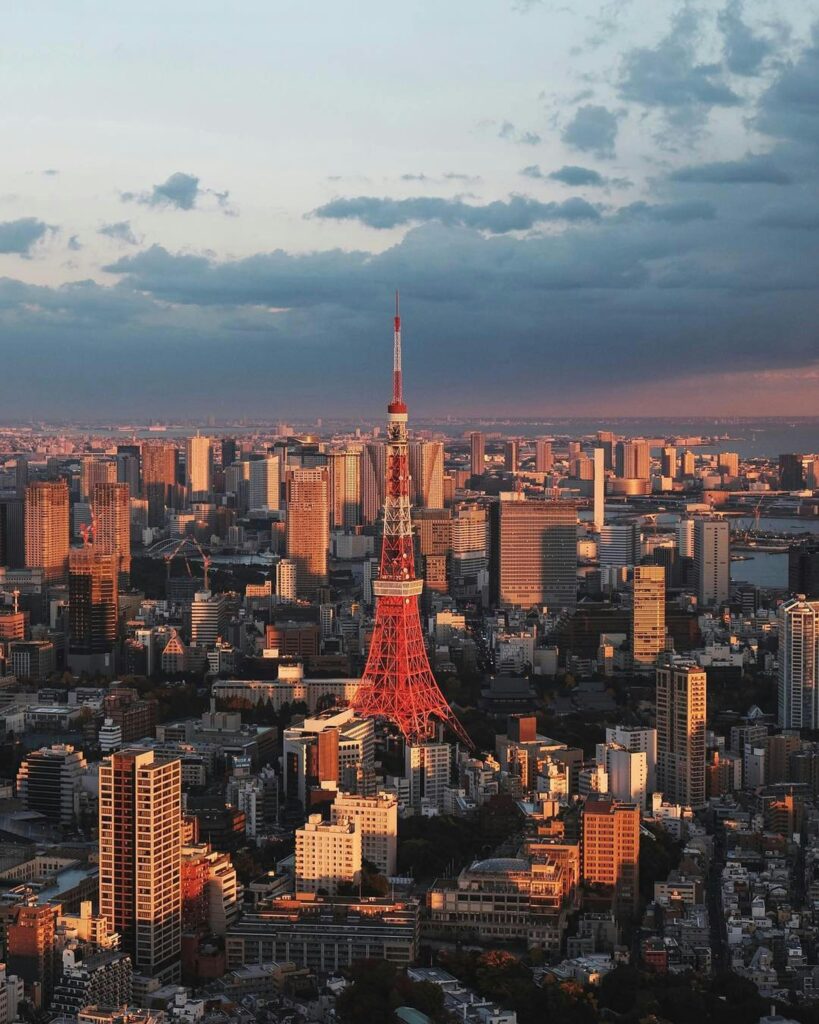
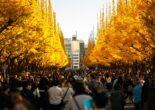
It’s also easy to reach. While routes vary by starting point, the tower is served by several nearby subway stations in Minato-ku and adjacent areas (with Tokyo Metro and Toei lines converging around the broader Shiba / Akabanebashi / Onarimon / Daimon / Hamamatsucho cluster). The official Tokyo Tower access information and maps are the best source for the exact station-to-walk combinations on the day you go. The fall foliage in this part of Tokyo tends to outshine the cherry blossoms, however.
Tokyo has plenty of newer, taller, and more technically advanced structures than the Tokyo Tower. Yet Tokyo Tower remains the one that shows up in movies, anime backdrops, wedding photos, and the mental map of first-time visitors. Part of that is cultural momentum: it became “the Tokyo symbol” early, and nothing ever truly replaced that role.
Another part is emotional. Tokyo Tower represents a particular story: postwar rebuilding, the arrival of TV culture, and Japan’s confidence that modern engineering could be both functional and beautiful. Towerpedia even preserves small, human-scale facts — like legends around couples watching the lights go out at midnight, or the meticulous hand-maintenance behind paint cycles.
So yes, you should go up. But you should also do the classic Tokyo thing: look at it from multiple angles. Catch it from a train window. Spot it between buildings. See it lit up on a winter night. Tokyo Tower works because it’s not only a destination — it’s a recurring character in the city’s daily life.
And in a place as relentlessly new as Tokyo, an old giant that still fits into the story is worth paying attention to.
Stay tuned for more exciting content like this! Follow us on our social media platforms and check out our blog regularly to stay updated on the latest news, trends, and insider stories from Japan. Don’t miss out on future updates — sign up for our newsletter for exclusive content delivered straight to your inbox!